
Get your house in order
Small Steps Vol. 122

Welcome back to the Small Steps newsletter. After an extended break we’re looking to bring back this channel with something a bit different. In addition to our usual wrap of links and news, we are going to be providing analysis and deeper dives into themes we’re seeing in the impact and VC sector.
We’ll expand on our position on AI in a later edition, given that as an impact investor we have a unique lens on this line of technology. But for now, we wanted to discuss something that’s been going around the watercooler here at Giant Leap: How companies should be leveraging AI.
What we’re thinking about
AI is the amplifier. Alignment is the strategy.
By Will Richardson
Earlier this year, markets did something unusual. They repriced software - not because a cohort missed earnings, but because a product release felt like a business model threat. After Anthropic launched a new automation tool, investors sold off software stocks on the view that AI can now run workflows, not just assist them.
The inbound that followed from LPs and fund managers was telling: what’s actually driving this, and how are startups suddenly disrupting incumbents faster than incumbents can respond?
My answer is simple, and slightly uncomfortable for large organisations: AI is not the strategy. It’s the amplifier. And the thing it amplifies most aggressively is organisational design.
The hidden tax was never effort rather it was coordination.
A lot of SaaS economics were built on seat-based pricing and the assumption that switching costs would stay high enough to make lifetime value (LTV) predictable. AI challenges both. When teams can change tools and models quickly, the productivity layer lifts above any single vendor. LTV becomes harder to forecast, reducing the need to commit to one stack for years.
In knowledge work, output rarely scales linearly with headcount. The real drag isn’t effort. It’s coordination: the reviews, approvals, handoffs, rework, and ambiguity that force people to spend time confirming what should already be clear. AI compresses that. When the first draft becomes cheap, the team that decides quickly becomes disproportionately advantaged.
Incumbents don’t lose because they’re dumb. They lose because they’re slow. And slowness is often a design choice.
Alignment isn’t a culture initiative - it’s a competitive advantage.
Patrick Lencioni’s The Advantage argues that organisational health - not strategy, not technology - is the ultimate competitive advantage. The most effective organisations are those where leadership is cohesive, clarity is shared, and that clarity gets reinforced consistently at every level. It’s not glamorous work. But it’s the work that determines whether everything else compounds or collapses.
In the context of AI, Lencioni’s framework has never been more relevant. AI doesn’t fix misalignment. It amplifies whatever a team already is.
If you’re aligned, AI multiplies shipping. If you’re misaligned, AI multiplies noise. More meetings, documents and dashboards. More “alignment work” that only exists because alignment doesn’t. It’s like a chaotic startup raising a big round and going on a hiring streak to put out fires - nothing becomes clearer, you just accelerate the existing dysfunction.
Real alignment is mechanical. Shared goals that are stable enough to matter. Priorities explicit enough to say no with ownership clear enough that work doesn’t boomerang between teams. Decisions pushed far enough down that the people closest to the work can move without permission slips. When that’s true, AI feels like a cheat code - not because it makes people smarter, but because it collapses the sludge between intent and output.
Organisational health is table stakes.
The market selloff was framed as a valuation story. It’s more useful to read it as an organisational story. AI is making design constraints visible, and in doing so, it’s making alignment - or the absence of it - something investors can increasingly price.
At Giant Leap, we look for founders who understand this distinction. Not just founders building with AI, but founders building organisations that can survive amplification. The ones who want to do the unglamorous work of getting their house in order.
Because here’s the uncomfortable truth for incumbents: the best AI strategy might start with a non-AI intervention. Get clear on what you’re actually trying to do, clarify ownership and shorten the distance between action and feedback. Then amplify.
The winners won’t be the companies with the most AI. They’ll be the companies whose operating systems are aligned enough to integrate and capitalise on it.
Capital is a force multiplier and so is AI. Both compound resilience in healthy organisations and both accelerate fragility in broken ones. The question for founders and investors alike isn’t whether to adopt AI - it’s whether your organisation is ready for it.
The organisations best positioned to survive amplification are also the ones most likely to use it well. For founders solving the world’s most pressing problems across climate, health and people, alignment isn’t just a growth lever - it’s the precondition for building something that actually matters.
For the road
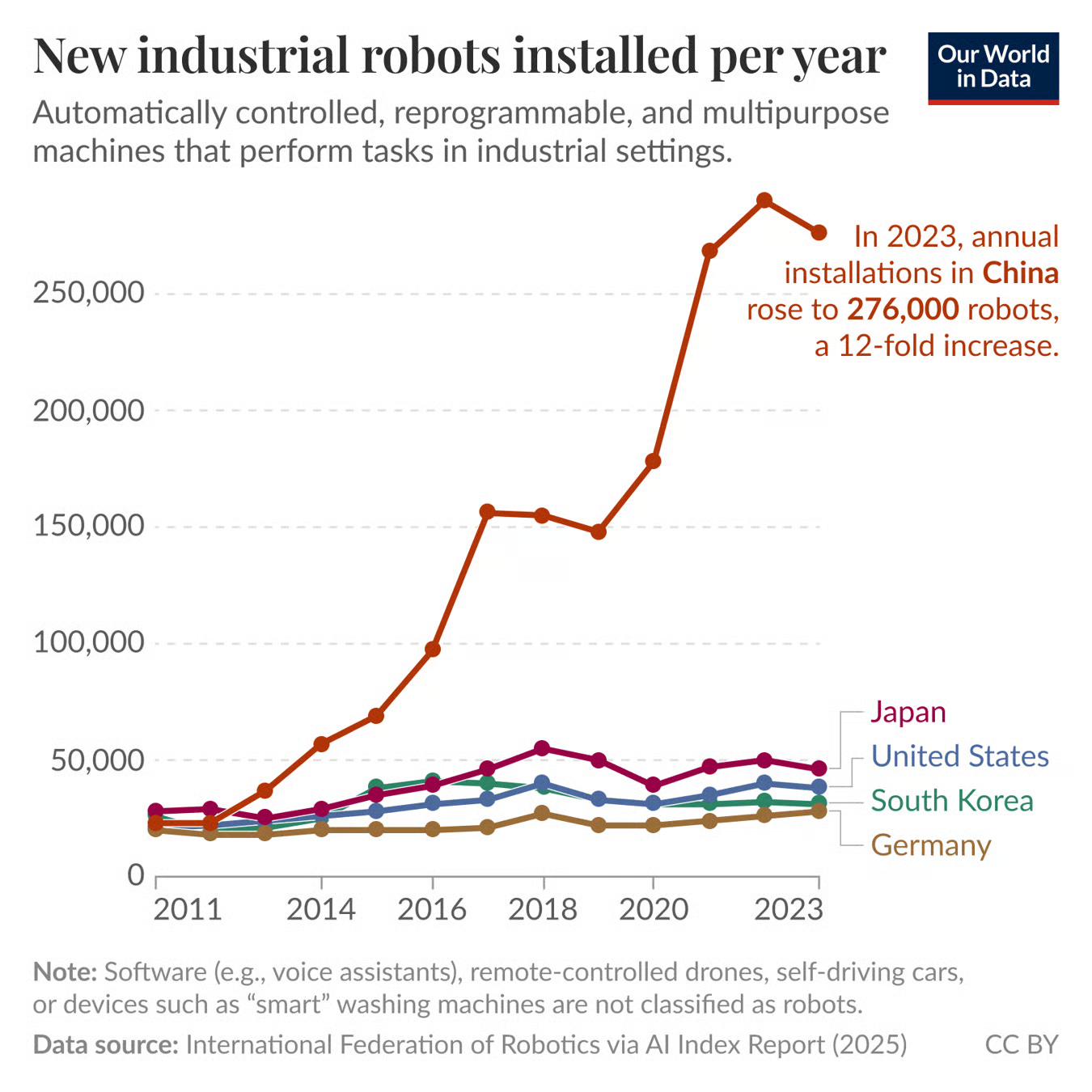
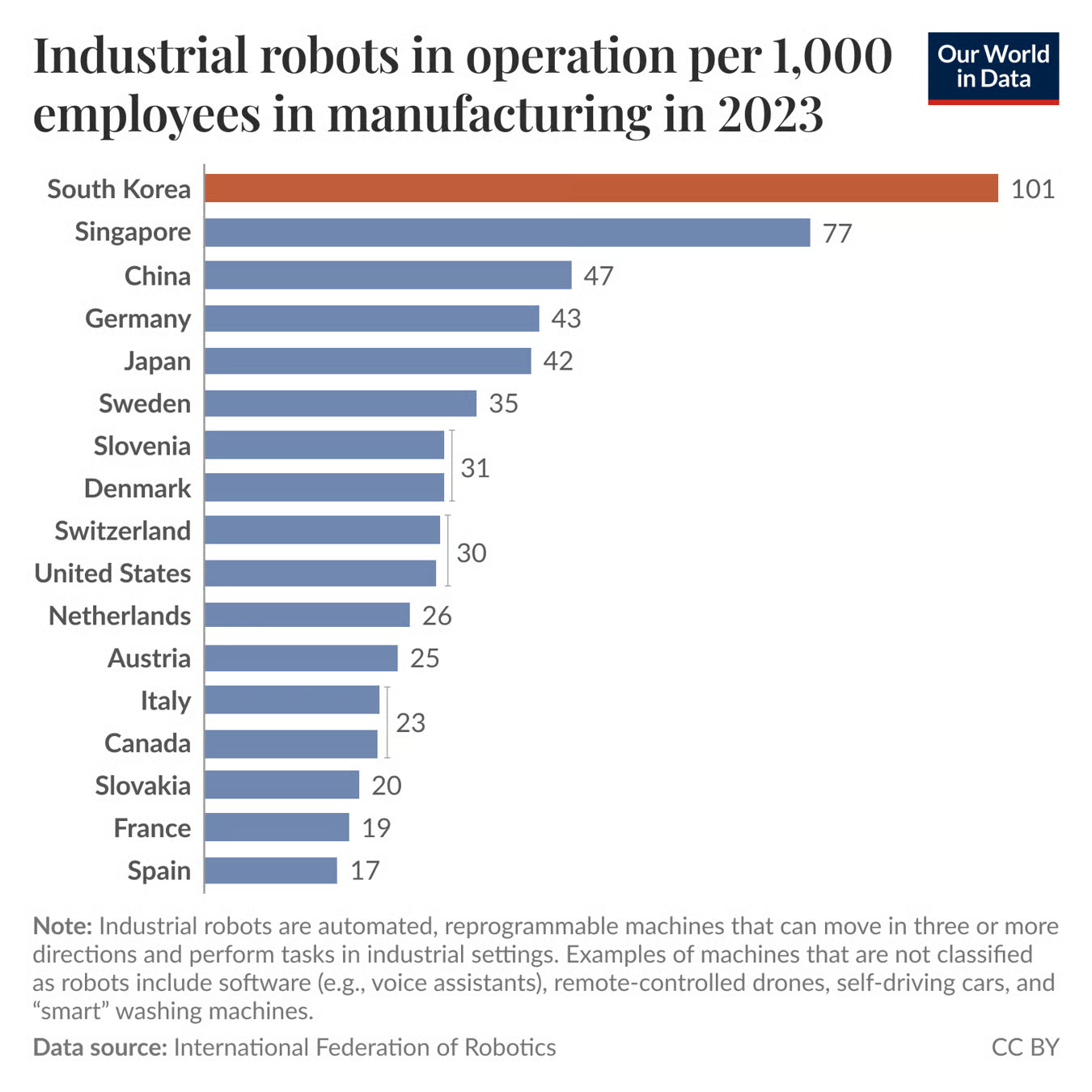
🤖 Robots take the nursing night shift. In a Taiwanese hospital, robots are taking over overnight transport rounds from nurses, saving 2-3 hours a day at a time. And in China at Lunar New Year, robots performed kung fu on stage to a crowd that didn’t quite know how to feel. The data underneath both stories tells you why it matters: in 2011, China was installing similar numbers of industrial robots as the US, Japan, and South Korea. By 2023, it was 12x more at 276,000 a year. South Korea now has more than one robot for every ten manufacturing workers. The technology has been moving faster than most of us noticed.
🐄 The climate fix that has to make sense for farmers too. Cattle globally convert 2–12% of everything they eat into methane and burp it into the atmosphere instead of turning it into milk or meat. That’s the energy efficiency problem hiding inside the climate problem, but solutions that only make the climate case rarely get adopted. Twynam’s deep dive maps out every major solution on the table right now: vaccines, seaweed additives, commercial feed supplements, and the criteria that separate what might work from what actually scales.
🩺 Surgery shouldn’t be the first answer but for too many women, it is. One in seven Australian women live with endometriosis. Best practice guidelines from Australia’s peak obstetrics body are clear: imaging comes first, surgery is a last resort, and repeated operations have no proven benefit. A seven-month Four Corners investigation found those guidelines aren’t always being followed and that some women are, in their words, “gaslit into thinking surgery is the only way to validate their pain.”
⚡We need all of it. And we need the grid to catch up. Start with the pace. In 2020, forecasts predicted global energy demand would grow 25% over a decade. It took four years. AI dominates the headlines, but demand is accelerating from every direction from data centres, EVs, industrial growth to rising temperatures.
As for what will power all of this, Brookfield’s latest global energy outlook is clear: we need all of it. Renewables are cheapest and fastest to build. Batteries, down 92% in cost since 2010, are making them dispatchable around the clock. Nuclear is back, with the global fleet projected to grow by a third. Gas remains the stabiliser while everything else scales. No single technology gets us there.
The constraint is the grid. More than 2,500 gigawatts of new projects are sitting in connection queues. Solar and wind overtook coal for the first time in 2025. The transition is happening. Fast enough is the question.
🧱 Why big companies keep losing to small teams. Most companies are layering AI onto existing workflows and wondering why the returns are modest. But this HBR piece has a clear answer: they’re diagnosing the problem wrong. Using Figma vs Adobe and Shein vs traditional fashion, the article shows that challengers don’t win by adopting better tools but they win by redefining the basic unit of work and reorganising coordination around it. Adobe built all the same features as Figma. The problem was the file. Worth asking: what’s your equivalent?
♿ They laughed at the bathtub with a door. In 2003, a plumbing veteran thought the walk-in tub was a joke - a bathtub with a door, built for seniors who couldn’t step over the rim. By 2005 he’d bought the company. Today it’s a US$750m market. This HBR piece coined the term “design amplification”: innovations built for people with disabilities tend to create products that work better for everyone, because the constraint forces a better question.
🧭 When ‘impact’ stops meaning something. One impact fund recently declared on stage: “Camouflage is the new green.” It was meant to be clever. Johannes Weber of Ananda Impact Ventures finds it alarming and writes plainly about why. Mandates are softening and defence investments are creeping in under impact branding, as the word “impact” is being stretched to cover almost anything that needs moral cover in a tough market. If you’re in the impact space and you’ve felt the ground shifting under the word, Weber’s piece names it clearly.
Helpful resources
🔖 What Founders Want: Provides a resource hub for startup founders (with a NZ focus): funding directories, grants, programmes and tools all in one place .
📚 Lucy Li from Seek Investments’s weekly edtech newsletter is for those who want to stay across what’s happening in edtech globally without building your own tracker. It covers funding, M&A, policy shifts, and trends across education software, AI teaching tools and workforce learning.
Giant leaps
🌱 Victoria’s top 20 tech startups included three Giant Leap portfolio companies: Mindset Health, Ovum and MoreGoodDays. The cohort is collectively worth billions, in an ecosystem that has grown 26x since 2016 to A$132 billion. More than half of Australia’s healthtech startups now call Victoria home.
🧠 There only 400 psychologists for tens of millions of IBS patients. Worth listening to Alex Noumidis, Co-founder and CEO of Mindset Health, talk through the Nerva platform and what it takes to build at-scale digital therapeutics.
🏗️ SPEC Toolbox raises A$3m. SPEC Toolbox started life as CLT Toolbox, a platform automating engineering specs for mass timber. Then the team realised the problem was much bigger. Designers across construction routinely avoid innovative sustainable materials because specifying them is technically complex. SPEC Toolbox automates that gap. They have 6,000+ users now across Europe, the UK, and North America.
💼 Women want security, safety, and the right to switch off. The top priorities for women at work in 2026 are not mentorship programs or leadership pipelines. They are job security, psychological safety and the right to disconnect. WORK180’s annual report surveyed 1,100+ women and found 58% say workplaces are improving, up 5% from last year. But 95% still face at least one barrier to success, and 1 in 5 say AI is making their role feel less secure.
New paths
🔋 Amber Electric is hiring for across roles from Office Manager & Executive Assistant, IT Operations Administrator, Senior Software Engineer, Senior Growth Designer (Product), Compliance Specialist, Regulatory Compliance Officer and Senior Product Marketing Manager.
🎧 Mindset Health is looking for a Fractional Medical Director (US).
🧻 Who Gives A Crap is hiring a Director of Performance Marketing (Remote) and Lifecycle Marketing Analyst (Remote).
Save the date
📅 March 6: Applications close for LuminaX’s Accelerator for Australian healthtech startups - Gold Coast, QLD. The program connects you to 40+ mentors, clinicians, experts and entrepreneurs - including Giant Leap Partner, Rachel Yang. Learn more here.
📅 March 10: Applications close for LaunchVic’s Basecamp. This is a no-cost education program by LaunchVic for seed to series A founders. Learn more and apply here.
📅 March 10-12: EnergyLab is hosting the Tech, Innovation & Startup Precinct as part of CAWSyd 2026. Check out all the precinct events here.
📅 March 12: Applications close for RMIT’s FounderHUB. The four-week program is for aspiring founders who are also RMIT students, staff, researchers and/or alumni. Learn more and apply here.
📅 March 12: Greenhouse’s Reverse Pitch Night: “Shut Up & Take My Money!” - Sydney. Climate investors take the stage for one-minute pitches about what they offer to founders - including Giant Leap Managing Partner, Will Richardson. Get tickets here.
📅 March 12: EnergyLab’s How To Get A Job In Climate Tech - Sydney. The event includes a panel discussing how to get a career in climate tech. Register for tickets here.
📅 March 13: Applications close for Ochre Indigenous Pre-Accelerator. The seven-week program is delivered online. Learn more and apply here.
📅 March 15: Applications close for EnergyLab’s Climate Solutions Accelerator 2026 cohort. The program is designed for companies with strong early traction and gearing up for significant scale or a Seed/Series A in the next 12-18 months. You can learn more and apply here.
📅 March 22: Applications close for ANDHealth’s ACTIVATE accelerator program for Victorian digital health startups. The six-month intensive experience features expert-led content tailored specifically for the sector, knowledge implementation phases to put learnings into practice, and real-time, one-on-one feedback from experts and mentors. Learn more & apply here.
📅 March 25-26: Impact Investing Summit - Sydney. The Summit brings together thinkers, funds and companies shaping the next phase of investing for positive impact. Tickets available here.
📅 April 30: Blackbird’s Sunrise Festival - Sydney. The Giant Leap team will be attending - come along and say hi! Buy tickets here.
📅 May 20-21: Digital Health Festival - Melbourne. DHF brings together the most influential leaders and innovators in healthcare with over 8,000+ attendees. Rachel Yang is speaking at the ‘Unlocking investment into women’s health’ session. Buy tickets here.